The Bussey-Saksida Touch Screen Operant Conditioning Chamber is a multi-paradigm device used to study operant conditioning in rodents. It features a large, high-resolution touchscreen that serves as the primary input/output interface for different tasks. This touch screen presents various visual stimuli, respond to animal touch inputs, and log their responses.
Additionally, the chamber includes operant conditioning tools like levers, nose pokes and food dispensers or lickometers, which are used to reward subjects for specific behaviors, such as pressing a button or touching a designated area on the screen.
The chamber is designed with a range of environmental controls and cues, including, lighting and sound. These settings can be customized to your experimental needs. Researchers can also program the chamber to create and control complex tasks and training programs, such as visual discrimination, memory tests, and attention tasks. The system automatically records various behavioral metrics, such as response times and accuracy, and stores detailed data for analysis.
The chamber is also valuable for pharmacological studies, as it enables researchers to investigate how various substances or treatments, such as drugs, affect behavior and cognitive abilities. In the field of comparative neuroscience, the device allows for the comparison of behavior across different species, offering insights into animal cognition and the neurological foundations of behavior.
Specifications
Mice
|
Rat
|
| Chamber size: 20cm (l) x 20cm (w) x 20cm (h) |
Chamber size: 30cm (l) x 30cm (w) x 30cm (h) |
| (2x) Retractable levers or nose pokes |
(2x) Retractable levers or nose pokes |
| (2x) LED visual stimuli |
(2x) LED visual stimuli |
| (1x) Touchscreen |
(1x) Touchscreen |
| (1x) Pellet Dispenser (or Lickometer) |
(1x) Pellet Dispenser (or Lickometer) |
| (1x) Pellet Receptacle |
(1x) Pellet Receptacle |
| Feces and urine tray |
Feces and urine tray |
| Sound attenuating cubicle with (1) speaker, (1) circulation fan, (1) IR light |
Sound attenuating cubicle with (1) speaker, (1) circulation fan, (1) IR light |
| Conduct Software (optional) |
Conduct Software (optional) |
Introduction
The Bussey-Saksida Touch Screen Operant Conditioning Chamber was developed by Dr. Jennifer Bussey and Dr. David Saksida who designed the chamber to address the limitations of traditional operant conditioning chambers, which they found were often less interactive and less adaptable for studying complex cognitive processes in animals.
The chamber can be used for multiple purposes such as in psychological testing to assess visual discrimination, working memory, task-switching abilities, and other cognitive processes in animals. In pharmacological studies, the chamber enables researchers to investigate how various substances or treatments, such as drugs, affect behavior and cognitive abilities. In the field of comparative neuroscience, the device allows for the comparison of behavior across different species, offering insights into animal cognition and the neurological foundations of behavior.
The motivation behind the invention was to create a more flexible and sophisticated tool that could support a broader range of behavioral tasks, particularly those that require the animal to interact with visual stimuli. Traditional operant conditioning chambers were typically limited to simple tasks like pressing levers or responding to cues in the environment. In contrast, the touch screen chamber allows for more complex, task-specific interactions, such as visual discrimination, working memory tests, and cognitive flexibility exercises, which are crucial for studying higher-order cognitive functions.
By incorporating a touch screen interface, the chamber provides a versatile platform for testing a variety of cognitive processes, including attention, memory, and decision-making. It also facilitates more precise data collection, allowing researchers to monitor detailed behaviors and responses with greater accuracy. The invention was intended to push the boundaries of behavioral neuroscience and provide more accurate and nuanced insights into animal cognition, learning, and the effects of different substances or conditions on behavior.
The Bussey-Saksida Touch Screen Operant Conditioning Chamber was developed to study advanced cognitive and behavioral research in animals, facilitating a deeper understanding of the neural mechanisms underlying learning and memory.
Features

Sound attenutating chamber
Dimensions 60 x 55 x 65 cm (width x depth x height)
Multi-layer sound-proof insulation material that attenuates environment disturbance
Automated LED house light
Automated IR light
Automated air circulation fan
Camera mount
Pull-out floor shelf (optional)
Open slot for Optogenetic, cannuals, cables etc (optional)
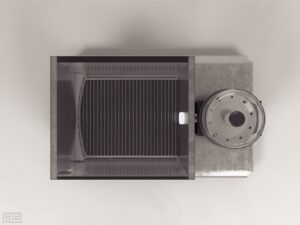
Chamber
Acrylic walls and base (Black or grey or blue or white)
Interior dimensions: Mouse: about 20x20x20 cm (LxWxH) to fit the grid of dimension 18x18 cm, Rat: about 30x30x30 cm (LxWxH) to fit the grid of dimension 27x27 cm, Custom dimensions available
Removable lid.
Removable feces catcher for easy cleaning
House light, two cue lights, speaker, one pellet dispenser, two levers (or nose pokes) with sensor detection.
Chamber construction supports optogenetic devices

Retractable levers
Two retractable levers are made of stainless steel mounted on the interaction panel
Width: 1.6 cm for rats and 1 cm for mice
Nose pokes also available
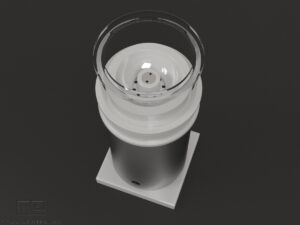
Pellet dispenser x1
The pellet dispenser is controlled by Conduct software to release pellets via protocol or lever press
20 mg pellet dispenser is the default choice (tested with pellets from Bio-Serv).
45 mg pellet dispenser is also available
Lickometers also available
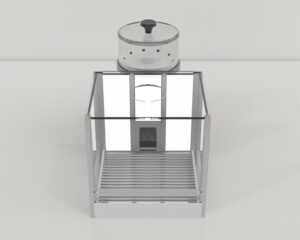
Touchsceen
Highly configurable touchscreen for multiple paradigms
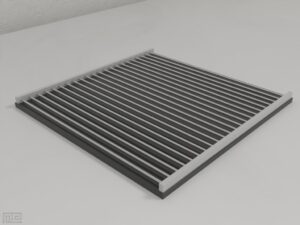
Shock grid (optional)
Specifcations: Constant current - 0.1 to 4.0 mA in 0.1 mA steps
Software
- Our Operant system has multiple software options to best suit your needs.
- Our Conductor software controls the system directly
- For those looking for protocol set-up combined with video tracking and analysis, the system is compatible with ConductVision, Noldus Ethovision XT,and ANY-Maze
- Each operant chamber includes a control box to control the chamber .
- The main controller connects to the PC via a USB (RS-232) cable and communicates with the software package on PC.
- Protocols can be set per chamber or per group so that both control and treatment groups can be tested simultaneously with the same or different parameters.
- The software supports up to 16 chambers simultaneously and allows individual chambers to start/stop and run independently
Each order comes with the option of one task type as default. Popular paradigms include:
| Paradigm Name |
Purpose |
Application |
| Visual Discrimination & Reversal Learning |
Tests learning ability, cognitive flexibility, and response inhibition |
Executive function studies, schizophrenia models |
| Pairwise Discrimination Task |
Assesses visual learning and object recognition |
Alzheimer’s disease models, perceptual learning studies |
| Trial-Unique Nonmatching-to-Location (TUNL) Task |
Evaluates spatial working memory and pattern separation |
Hippocampal function studies, neurodegeneration models |
| Paired-Associate Learning (PAL) Task |
Tests associative memory and object-location binding |
Alzheimer’s disease models, aging studies |
| Delayed Matching-to-Sample (DMTS) Task |
Assesses short-term memory and delay-dependent learning |
Memory decay studies, cognitive aging research |
| Five-Choice Serial Reaction Time Task (5-CSRTT) |
Measures attention, impulsivity, and response control |
ADHD models, frontal cortex function studies |
| Progressive Ratio Task |
Evaluates motivation and effort-based decision-making |
Reward processing studies, depression models |
| Probabilistic Learning Task |
Tests reinforcement learning and uncertainty processing |
Dopamine-related decision-making studies, psychiatric disorder models |
| Object-Location Contingency Task |
Examines spatial learning and memory |
Hippocampal research, spatial cognition studies |
| Serial Reversal Learning Task |
Tests cognitive flexibility and adaptability |
Frontal cortex function research, neuropsychiatric disorder studies |
- Maze Engineers can collaborate closely with the user to enhance software packages to their needs
- Software customizations and 2+ paradigm packages upon request


