Standard: ASTM C124, UNI 8020-A, AASHTO T120
Concrete Flow Table Apparatus
Concrete Flow Table Apparatus is used to determine the workability and consistency of fresh concrete by measuring the diameter of the circular spread. Mimic the compaction experienced during concrete placement, a conical mold filled with concrete is repeatedly lifted and dropped onto the surface
This test helps to assess the workability and consistency of the concrete, which provides insight into how well the concrete floats and compacts, aiding in determining its suitability for various construction applications. The results obtained from the Concrete Flow Table test can provide valuable information for adjusting the mix proportions or additives to achieve the desired properties of the concrete mixture
Features of Concrete Flow Table Apparatus
- 700mm Flow Table
- Lifting Mechanism for elevating and releasing the flow table
- Leveling Screws to ensure proper alignment and leveling of the apparatus before testing commences
- A Graduated Ruler helps in measuring the spread of concrete once released from the flow table
- Base to support the flow table and associated components
Standard: ASTM C124, UNI 8020-A, AASHTO T120
ASTM C124, established by ASTM, specifies requirements for testing concrete masonry units (CMUs), also known as concrete blocks or bricks. It covers dimensions, compressive strength, absorption, and moisture content. The standard includes guidelines for manufacturing, sampling, and testing to ensure quality and performance. Compliance guarantees that CMUs meet construction project specifications
This standard is established by the Italian National Unification Organisation (UNI), and focuses on testing concrete and concrete aggregates. It encompasses procedures for assessing properties such as compressive strength, flexural strength, density, and consistency. The standard offers guidance on sample preparation, testing methodologies, and results reporting. Compliance with UNI 8020-A guarantees that concrete utilized in construction projects aligns with mandated quality standards and performance criteria
AASHTO T120, published by AASHTO, focuses on testing concrete aggregates for abrasion resistance. It details the procedure using the Los Angeles abrasion machine to assess resistance to repeated abrasion, mimicking pavement wear and tear. Compliance ensures that aggregates for highway construction possess sufficient abrasion resistance, enhancing pavement durability
Test Procedure of Concrete Flow Table Apparatus
- Concrete Sample Preparation: The concrete mixture must be prepared according to the desired specifications, ensuring it's properly mixed to achieve uniform consistency
- Setup: Set up Flow Table Apparatus on a secure surface and ensure it's properly leveled using the adjustable leveling screws or feet
- Mould Preparation: Place the cylindrical mould or container on the flow table
Ensure the interior surface is clean and lubricated to prevent sticking of the concrete
- Filling the Mould: Carefully pour the prepared concrete mixture into the mould, ensuring it is filled to the desired level
- Lifting Mechanism: Activate the lifting mechanism to raise the flow table to its highest position
- Release: Once the flow table is raised, release the lifting mechanism to allow the flow table to drop freely. This initiates the spreading of the concrete
- Measurement: Use the graduated ruler or scale mounted vertically on the frame to measure the diameter of the concrete spread as it reaches its maximum flow
- Timing: Simultaneously, start the stopwatch or timer to record the time it takes for the concrete to spread to the desired diameter
- Observation: Observe the flow of concrete to ensure it is uniform and free from segregation or excessive bleeding
- Cleanup: After the test is complete, clean the flow table and mould thoroughly to remove any residual concrete
- Data Recording: Record the measured flow diameter and the corresponding time taken for the concrete to spread
- Analysis: Analyse the test results to assess the workability and consistency of the concrete mixture, considering factors such as flow diameter and spreading time
- Repeat: If necessary, repeat the test with additional concrete samples to ensure consistency and accuracy of the results
- Documentation: Document the test procedure, results, and any relevant observations in accordance with applicable standards and specifications
Technical Specifications of Concrete Flow Table Apparatus:
| Model Number |
NL 4010 X / 001 |
NL 4010 X / 002 |
| Dimension LxWxH |
700 x 762 x 650 mm |
1050 x 762 x 650 mm |
| Diameter of Table |
Ø 762 mm |
Ø 762 mm |
| Height of Drop |
12.5 mm |
12.5 mm |
| Approx. Weight |
100 kg |
115 kg |
| Power |
- |
220 V, 1 ph, 1 Hp |
| Type |
Manual |
Motorized |
Unit Consists of:
| Model Number |
Parts Description |
Part Description |
| NL 4010 X / 001 – P 001 |
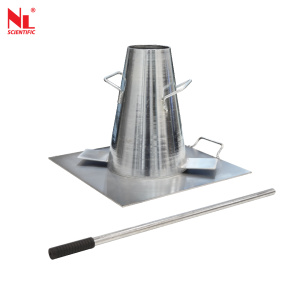
Flow Mould (mm)
Upper : ( Internal Dia. - 170 ) ( Outer Dia. - 204 )
Lower : ( Internal Dia. - 250 ) ( Outer Dia. - 275 )
|
| NL 4013 X / 001 – P 003 |
Tamping Rod |
| NL 4010 X / 002 – P 001 |
- |
Rotation Motor 220 V, 1 Hp |
| NL DTC – 100 |
- |
Digimatic Timer Controller |